The pearl wedding anniversary is 30 years of marriage. Pearl is the traditional UK material for year 30; the modern list gives diamond instead, which is one of the years where the two conventions part company.
That's the answer. Below: why the two lists disagree here, what "cultured" means on a price tag and why it is on almost every one, and how to mark the year without buying a stone at all.
Why the two lists disagree at thirty
The traditional British list gives pearl. The modern list, which fills in every year and came from jewellers in 1937, gives diamond.
It is worth noticing which direction that substitution runs in. The modern list swaps a modest organic material for the most expensive stone in the shop. That does not make it wrong to follow - plenty of couples mark a thirtieth with diamond quite happily - but it is useful to know that the "modern" convention here originated with people who sell diamonds.
Debrett's gives pearl for the 30th and no diamond, so on the British list the answer is pearl.
Thirty is a comparatively new anniversary
Thirty sits between the two anniversaries that do reach back to the Middle Ages - the silver at 25 and the golden at 50, marked with wreaths per Debrett's - and was written into the sequence long after both. the silver wedding page sets out how the list grew to cover every year.
Practically, that means the thirtieth is the first big anniversary after the silver wedding, and it usually gets a dinner rather than the party the 25th got.
Does the 30th get a message from the King?
No. Thirty years is half the distance to the threshold, which is the diamond wedding at 60. The qualifying anniversaries, and how to apply.
Almost every pearl you can buy is a cultured pearl
This is the thing to understand before you spend anything, because it explains a price range that otherwise looks irrational.
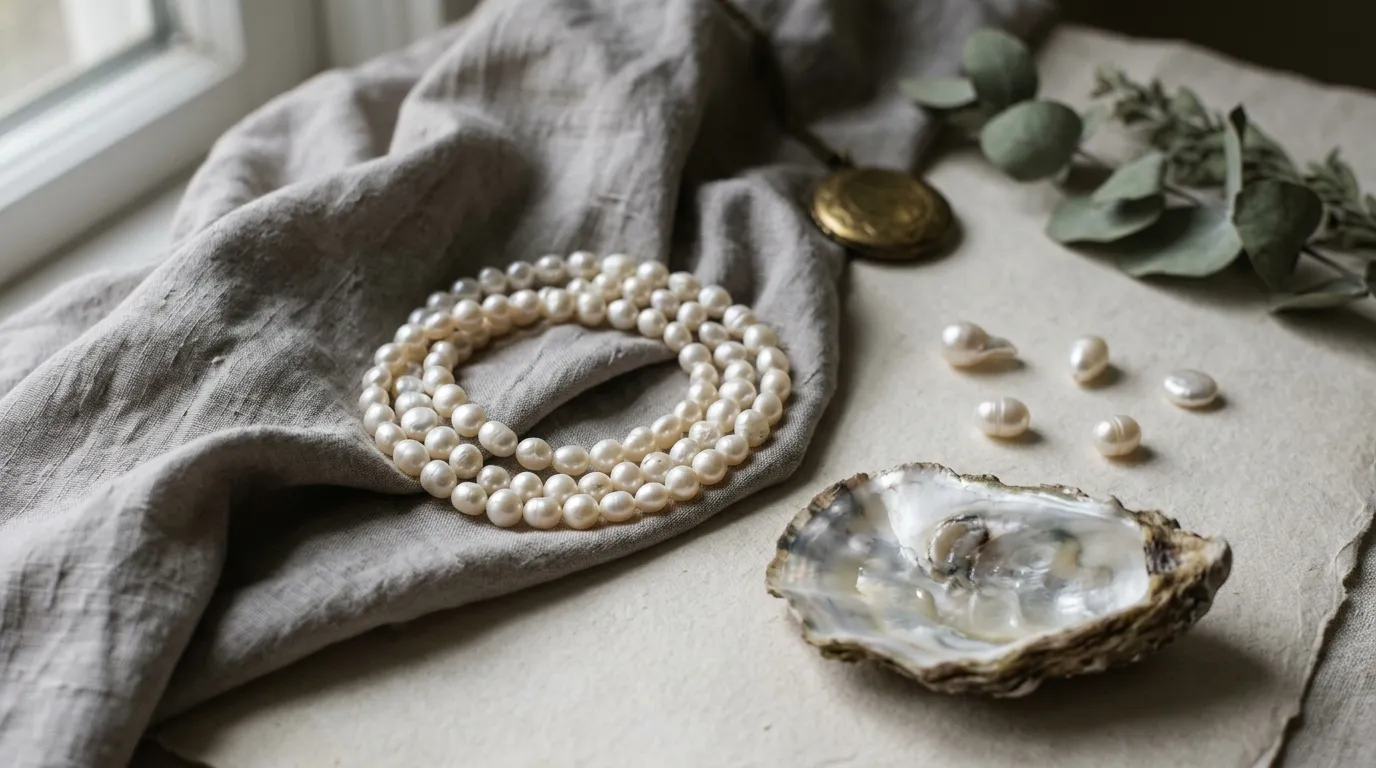
Natural pearls - formed without human intervention - are rare and priced accordingly. Effectively all pearls sold as jewellery today are cultured: grown in a farmed oyster or mussel after a deliberate implant. They are real pearls, made of the same nacre by the same animal; the difference is how the process was started.
The word matters legally as well as commercially. Trade nomenclature is codified internationally in the Blue Books published by CIBJO, the World Jewellery Confederation, whose rules reserve the term "cultured" for cultured pearls and no other material. In practice: if a seller says pearl where they mean cultured pearl, that is a description worth querying, and a reputable jeweller will state which it is without being asked.
The practical version: expect cultured, ask for it in writing, and treat any unqualified claim of a natural pearl at an ordinary price as a reason to walk away.
How a cultured pearl is made
Worth knowing, because it explains why "cultured" is not a euphemism for fake.
A natural pearl, per the Gemological Institute of America, forms in the mantle tissue of certain molluscs, usually around a microscopic irritant, and always without human help of any kind. That is the rare thing.
A cultured pearl is the same biology, deliberately started. A technician takes mantle tissue from a mollusc of the same species and inserts it into a host - either with a shell bead into the gonad, or as tissue pieces alone into the mantle. Where a bead is used, the tissue grows a sac around it and secretes nacre inward onto the bead. Where no bead is used, nacre forms around the implanted tissue itself. The molluscs are then tended until harvest.
So the pearl is real nacre laid down by a real animal. What was manufactured is the beginning, not the pearl.
The four types, and which one you are being offered
Price differences between pearls that look broadly similar usually come down to type. There are four major kinds of cultured whole pearl.
- Akoya. A saltwater pearl, white or cream, the classic single-strand necklace. Produced in Japan and China.
- South Sea. From Australia, Indonesia and the Philippines. White to silver or golden depending on the oyster. Large, with thick nacre from a long growth period and narrow growing conditions - which is what makes them expensive.
- Tahitian. Cultivated mainly around French Polynesia, and often called black pearls. Grey, black or brown, frequently with blue, green, purple or pink overtones.
- Freshwater. The most commonly produced, with a remarkable range of sizes, shapes and colours, and lower price points. Usually grown in lakes and ponds, often several pearls in one mollusc. China is the leading source.
For a thirtieth anniversary, freshwater is where most sensible budgets land and there is nothing second-rate about it. If you are being quoted South Sea prices, the size and the nacre thickness should be visible.
Bodycolour, overtone and orient
Three words that explain most of what a jeweller is charging for, and that almost no shop explains.
The bodycolour is the main colour - white and cream are most familiar, black, grey and silver are fairly common, and the range extends much further. The overtone is an additional colour modifying it, typically pink (sometimes called rosé), green, purple or blue. Some pearls also show orient, the iridescent shimmer that appears to sit a little under the surface.
Orient is the thing that makes a strand look alive rather than painted, and it is the difference people notice without being able to name. If you are choosing between two strands at similar money, this is the axis to look along.
Pearl as a look
A strand of good cultured pearls is a real expense, and a thirtieth anniversary does not require one.
Mother-of-pearl, an iridescent glaze, a pearlescent finish, anything sea-toned: all of it reads as pearl for the purpose of the occasion. Debrett's is explicit that the list is "merely a suggestion, not a prescriptive set of instructions", and thirty years of marriage is not the moment to start taking a Victorian gift chart literally.
What people give
Pearl jewellery is the direct route. Beyond it, thirtieth-anniversary gifts tend to work best when they gather up the three decades rather than announce the number - the marriage is the subject, not the arithmetic.
Avoid anything engraved "30 years" and nothing else. It records the figure and says nothing about the couple.
Check any other year: the UK anniversary list, 1st to 70th. For what to give at thirty, see the 30th anniversary gift guide. The milestone before this one is the silver wedding; the one after is ruby at forty.