Twenty years is china. Cotton, crystal and gold all reach this list carrying rules about what they may be called. China's rules are a different kind of thing: they govern what the object is allowed to release into your food.
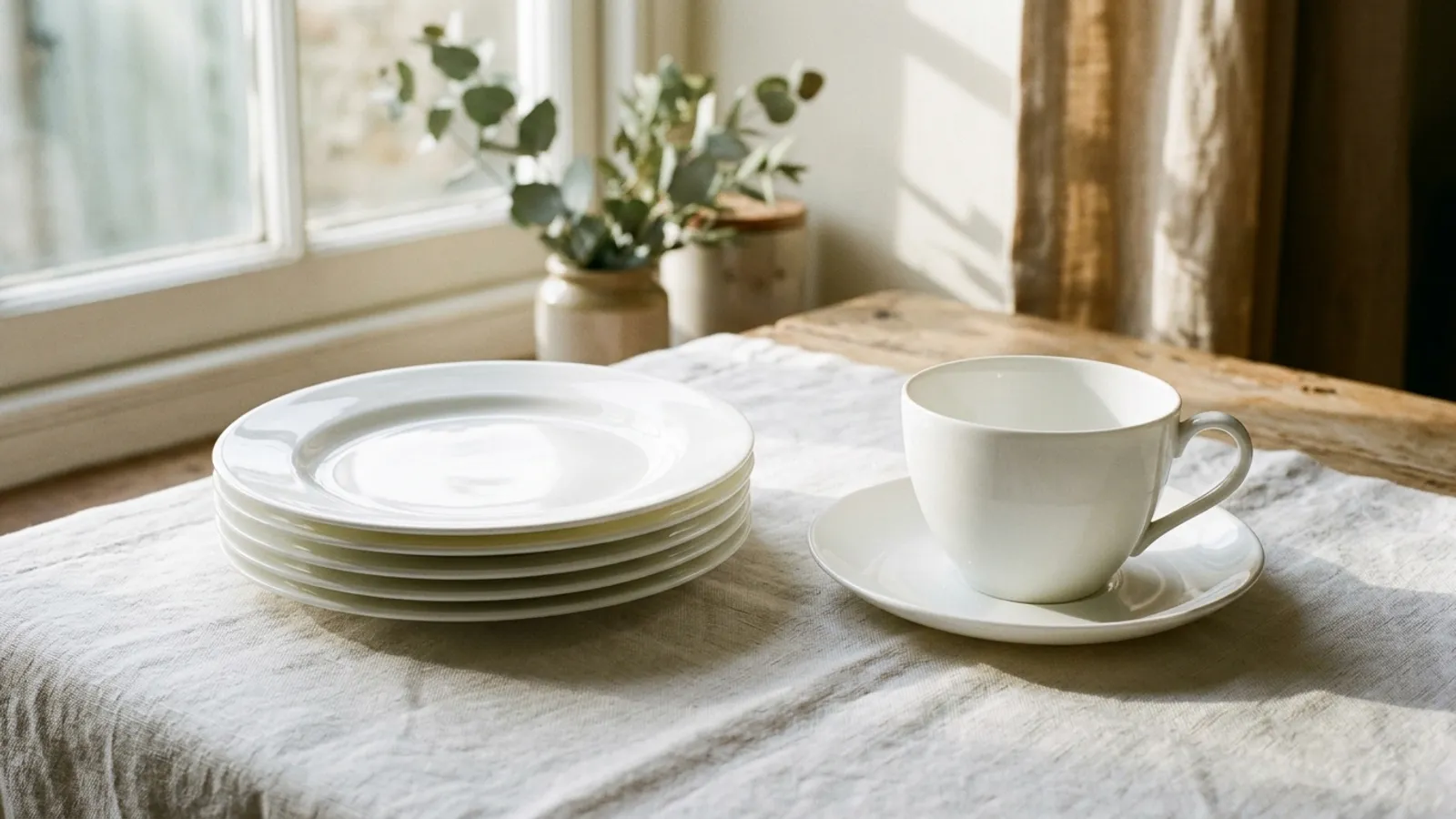
A plate and a teacup are different things in law
Ceramics that touch food are covered by The Materials and Articles in Contact with Food (England) Regulations 2012. Regulation 10 sets limits on how much lead and cadmium may migrate out of the glaze, and it does not set one limit - it sets three, by the shape of the object:
- Things that cannot be filled, and shallow things under 25mm deep - a plate, a saucer, a flat dish. Lead 0.8 mg/dm², cadmium 0.07 mg/dm².
- Everything else that can be filled - cups, bowls, jugs, a teapot. Lead 4.0 mg/l, cadmium 0.3 mg/l.
- Cooking ware; packaging and storage vessels holding more than three litres. Lead 1.5 mg/l, cadmium 0.1 mg/l.
They are not quite absolute caps. Regulation 10(5) of the same instrument lets a single article exceed a limit by up to 50% and still comply, provided at least three more of the same shape, dimensions, decoration and glaze are tested and their average stays within the limit, with none of them over by more than half. It is a batch tolerance, not a loophole - but it means a figure is a test result about a production run rather than a promise about the one cup in your hand.
Look at what changes between the first two: not only the number but the unit. A plate is measured per square decimetre of surface, because what matters is the area your food sits on. A cup is measured per litre, because what matters is the volume sitting in it. The law is reasoning about how you use the object.
That is worth knowing for a twentieth-anniversary present, because the classic gift is a display piece - and a decorative plate that was never intended to come into contact with food is not caught by these regulations at all. If it is going on a wall, that is fine. If it is going under a slice of cake, it is a different question, and the answer is on the box or from the seller.
Where china sits on our own list
Ceramic turns up three times in the British run: bronze or pottery at eight, willow or pottery at nine, and china at twenty. The earlier two offer a choice; twenty does not. The list treats them as separate presents - earthenware early, the fine stuff two decades in - while the food-contact rules above make no such distinction. A hand-thrown pottery mug from year eight and a bone-china teacup from year twenty sit in the same legal category and are tested the same way.
What the list is tracking is not the material's chemistry. It is what a couple can afford and are ready to own: a mug you can drop at eight, a service you would not, at twenty.
One thing we could not establish. "Bone china" has a British Standard behind it, and the figure quoted secondhand is a minimum proportion of tricalcium orthophosphate in the fired body - but BSI standards are paywalled, we have not read the primary, and more than one number circulates. So we are not going to print a threshold we cannot check. If a seller quotes you one, ask which standard and which edition.
Five gift ideas for the twentieth
A service you will eat off
The unromantic truth about display china is that it is dusted more often than it is used. Two good place settings beat a boxed twelve nobody unwraps.
One replacement piece
Twenty years into a marriage, somebody has broken something from the wedding list. Replacing the exact piece is a better gift than starting a new set.
Something thrown by a named person
Studio ceramics put a maker's mark on the base. In twenty years' time that mark is what makes it traceable, and traceable is what makes it an heirloom rather than a plate.
A repair, in gold
Kintsugi joins broken ceramic with lacquer and gold rather than hiding the break. As a twentieth-anniversary metaphor it is almost too on the nose, and it is still the best thing you can do with a cracked piece you both like.
Something that is not china at all
Twenty years in, most couples own all the crockery they will ever need. That's a practical objection rather than a romantic one, and it is usually the right one.
Where twenty sits: between crystal at fifteen and silver at twenty-five. The full run is on the UK anniversary list.
Related anniversaries: 15th: crystal · 25: silver · the full anniversary list · gifts by year