Year three asks for leather. It is also a year where the word on the label carries far less weight than it looks - and the reason is a gap in the law that nobody selling you a leather gift is going to mention.
Leather is regulated as a shoe. As a gift, we could not find a rule
Debrett's gives leather for the third. Buying it is where the year gets interesting.
Britain polices what several of these materials may be called: cloth has its labelling regulations, crystal has a composition standard, and four metals are covered by the Hallmarking Act. Leather goods fall between all of them. Cloth has the labelling rules the cotton year is built on. Shoes have the Footwear (Indication of Composition) Labelling Regulations 1995, which apply to footwear of all descriptions - bar second-hand, protective and asbestos-containing footwear, and play footwear for under-14s - and require whatever makes up 80% of the surface area of the upper, the lining and sock, and the outer sole to be named on the label, leather among the categories they list. Worth knowing if the boot you are looking at is sold as protective.
Now look at what people give at three years. A wallet. A journal. A photo album. A watch strap. A desk mat. Not one of those is a shoe, so the footwear rules never reach them, and they are not cloth either. We went looking for an equivalent covering leather goods in general and could not find one - which isn't the same as proving none exists, but it is the honest result of a morning in the Trading Standards guidance.
The consequence is worth carrying into a shop. On a walking boot, the word leather is doing accountable work. On a leather-bound album, it is a phrase whose meaning is set by whoever is selling it.
So ask the questions the label will not answer
Not because leather sellers are crooks - most are not - but because the vocabulary is unpoliced and the differences are real:
- Which part of the hide? In trade usage - not in any definition we could find - full-grain keeps the outer surface and its markings and wears in rather than out, top-grain has been sanded smooth, and "genuine leather" confusingly tends to mean the layers below both. Ask which the seller means.
- Is it a single piece or is it bonded? Bonded leather is offcuts and fibre glued onto a backing. It is a legitimate product sold honestly and a poor one sold as leather.
- How was it tanned? Vegetable-tanned develops a patina and darkens with handling; chrome-tanned is softer and more colour-stable. For a gift meant to age visibly, vegetable tanning is the one that rewards you.
A maker who works in leather answers all three without pausing. A shop that cannot answer any of them is selling you a word.
Five gift ideas for the third
A notebook that will be filled and replaced
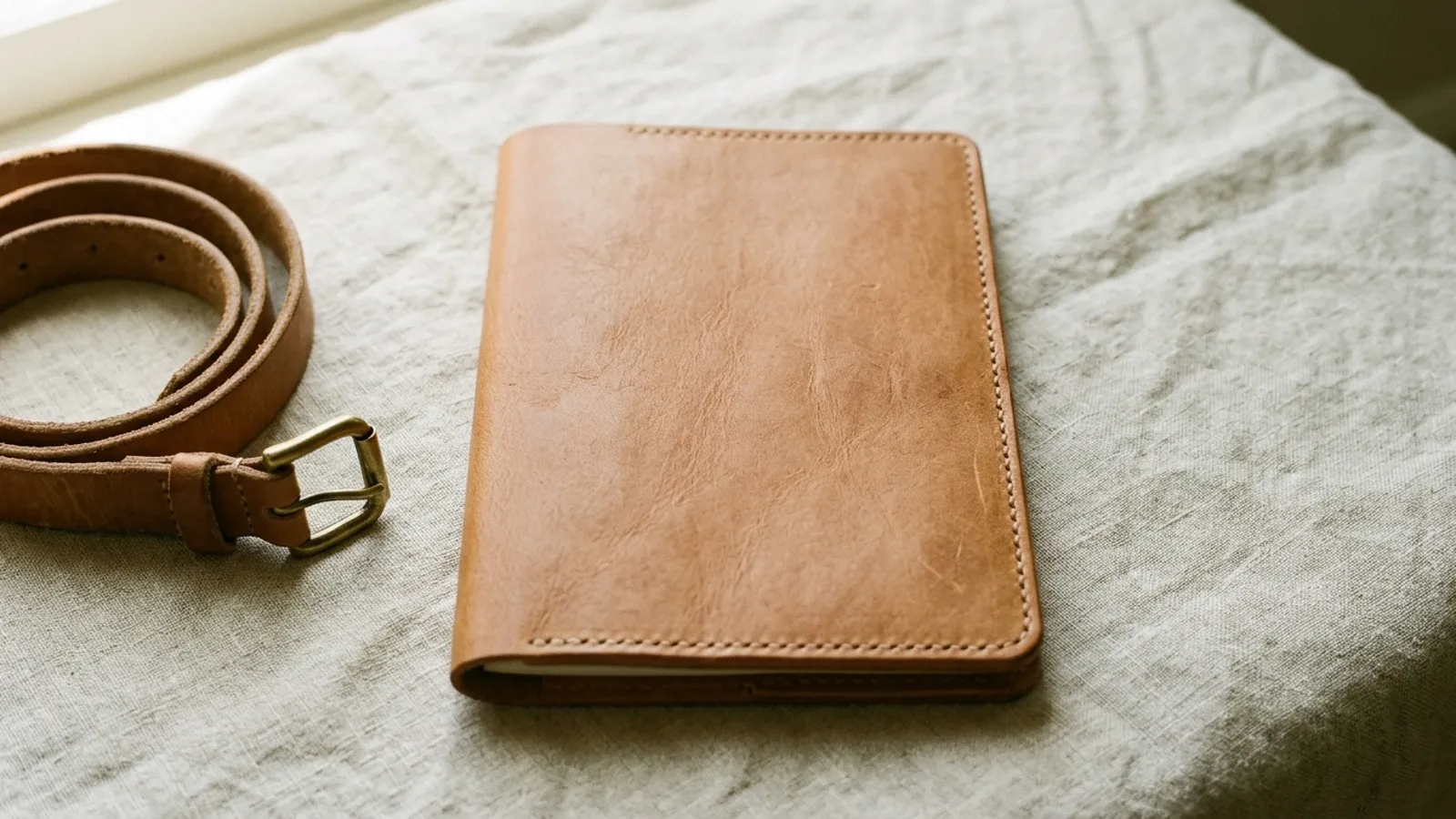
The one leather object that improves fastest, because it gets handled daily. Refillable covers outlive their contents by decades.
A photo album, bought with something to put in it
A leather cover will outlast every print inside it. Order the prints at the same time, or what you have given is an empty box with good stitching.
Something with a strap
A watch strap, a camera strap, a bag handle. Leather that moves against skin ages faster and better than leather that sits still.
A repair rather than a purchase
A jacket relined, a bag restitched, boots resoled. Unromantic on paper, and it treats leather as a thing that lasts rather than a thing you buy.
Leather-adjacent, if neither of you wants hide
Waxed cotton and cork both age the same way and take the same knocks.
What to avoid
- "Genuine leather", unqualified. With no instrument we could find policing the phrase for goods like these, an unqualified label tells you close to nothing.
- A leather gift for someone who does not want leather. The list is a suggestion. Debrett's says so itself.
Where three sits: after cotton at two and before flowers and fruit at four. The whole run is on the UK anniversary list.
Related anniversaries: 2nd: cotton · 4: fruit or flowers · 10: tin · the full anniversary list · gifts by year